Book a Call
Vertical Compliance Hub · Weight Loss & GLP-1 Telehealth · Protection segment

Meta Ad Compliance for Weight Loss & GLP-1

Weight loss and GLP-1 telehealth sits at Meta's highest enforcement tier. Meta places the vertical under its Drugs and Pharmaceuticals industry, its most-policed advertising category. Categorical enforcement means Meta's AI risk model applies elevated scrutiny regardless of individual ad compliance. This is compliance infrastructure built for platform governance, not another appeal layer.

7 sections in this hub5,000+ ad accounts observedDrugs & Pharma Meta industry #11Categorical enforcement elevated risk baseline
In this hub

Categorical enforcement mechanics, the four enforcement scenarios, and the recovery path

SECTION 01 · Categorical enforcement

Why this vertical sits at Meta's highest enforcement tier
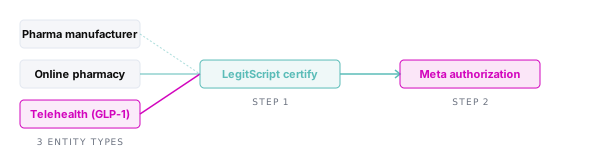
GLP-1 telehealth authorization flow: LegitScript certification then Meta authorization

Weight-loss and GLP-1 telehealth advertising lives under Meta's most-restrictive policy category: Drugs and Pharmaceuticals (Meta's canonical restricted industry #11). Enforcement is categorical, which means Meta's AI risk model treats GLP-1-adjacent content with elevated scrutiny regardless of how compliant the specific ad appears.

The operational implications:

  • Some false-positive rejections are structurally baked in. Even fully compliant ads get rejected; the appeal pipeline exists because Meta itself acknowledges the over-rejection rate in this category.
  • Account-level disablement triggers fast. Repeat policy rejections on a single ad account drive disablement within 30 to 60 days.
  • Business-identity reputation is the real currency. Meta correlates campaign profile, landing page, and payment behavior across all accounts under one business identity. One identity with multiple disablements gets the entire Business Manager's account-creation cap dropped.
  • Compounded GLP-1 is enforced separately from FDA-approved GLP-1. Meta treats these as different products. Compounded semaglutide and tirzepatide require explicit "not FDA-approved" disclaimers and licensed-prescriber documentation.

Across our coverage in this vertical, GLP-1 telehealth accounts experience suspension cascades at materially higher rates than supplements or non-restricted verticals, and the cascade timing is faster (ComplyAi Intelligence Graph, Q2 2026). The Enforcement Behavior signature is category-level, not creative-level, which is why compliance work here has to address the vertical-level risk model, not just the individual ad.

The authorization gate that stops most GLP-1 ads before category-level enforcement even fires

The most common GLP-1 telehealth enforcement pattern in our corpus is not creative-level rejection or restriction. It is the account-never-authorized failure mode: advertisers who launch GLP-1 campaigns without the prerequisite third-party certification, whose ads then get rejected across the board regardless of creative compliance.

Meta's Prescription Drugs policy (Business Help Center: "About Meta's Prescription Drugs advertising policy") documents the gate. Prescription-drug advertising requires prior Meta authorization, and authorization is only available to three entity classes: pharmaceutical manufacturers, online pharmacies, and telehealth providers.

For GLP-1 telehealth specifically, the authorization path is:

  • Certify the business with LegitScript. LegitScript is the independent third-party verifier Meta relies on for prescription-drug advertiser eligibility. Certification is per country. Without an active LegitScript certification, Meta will not accept the application in the next step.
  • Submit for Meta authorization. Once LegitScript-certified, apply through the Authorizations and verifications tab in Meta Business Suite. The application requires the LegitScript-certified URL, business name, and the specific ad accounts to authorize.
  • Maintain LegitScript. Meta revokes authorization if the LegitScript certification lapses.

Pharmaceutical manufacturers have an alternative path (Meta's internal review, requiring FDA registration or equivalent) that does not depend on LegitScript. Telehealth providers do not have this option; LegitScript is the mandatory route for that entity class.

Country scope is narrow. Meta permits prescription-drug advertising in three countries only: United States, Canada, and New Zealand. Advertisers must be certified in the specific country they target, and audiences must be 18 or older.

What the authorization allows. Meta's policy explicitly permits authorized telehealth advertisers to run ads with efficacy comparisons, sales-language CTAs, delivery details, price disclosures, and telehealth-consultation language. The full functional range of prescription-drug promotion sits behind the gate. The categorical-enforcement mechanics in the next section operate downstream, filtering compliant vs non-compliant creative from within the authorized advertiser pool.

On compounded semaglutide and the pharmaceutical-manufacturer definition. Meta's public entity-type language includes "compounding" as one of the qualifying activities under Pharmaceutical Manufacturers. A compounding pharmacy that produces semaglutide can therefore route through the manufacturer authorization path (Meta's internal review or LegitScript). Whether Meta's enforcement system treats a specific compounded product with the same signal weight as an FDA-approved brand is a separate operational question, and one that varies by product and marketing surface. Section 02 covers what we observe about that variance.

SECTION 02 · Four scenarios

The four enforcement scenarios that hit this vertical

Four distinct enforcement events fire against GLP-1 telehealth accounts. Each has a different signal source, a different remediation path, and a different severity. Read them in escalation order (ad-level → account-level → multi-account).

Scenario 01

Ad rejected for misleading health claims

The most common rejection. Triggered by efficacy language, before-and-after framing, quantified outcome claims ("Lose 30 lbs in 60 days"), or personal-attributes targeting language ("Are you overweight?"). The underlying violation code sits in the misleading-claims or prohibited-health-content policy family. The Enforcement Signal Layer surfaces the specific code; Ads Manager surfaces only the generic category.

Ad-level · Most common
Scenario 02

Brand-drug conflation without pharmacy authority

When ad copy or landing page uses brand-name FDA-approved drug references (Wegovy, Ozempic, Mounjaro, Zepbound) without holding pharmacy authority. Even legitimately licensed telehealth that prescribes compounded equivalents gets flagged for naming the brand drugs. Meta's review reads the brand names as authority claims and applies the pharmacy-authority check.

Ad-level · Authority mismatch
Scenario 03

Account restricted with spend-cap reduction (silent)

The quietest enforcement signal in this vertical. Daily spend limits get compressed before any explicit rejection lands. The trigger is usually an account-quality score adjustment upstream, often from prior policy-recurrence patterns. This is the enforcement cascade rendered as budget symptoms; the full mechanics are covered on /solutions/recovery Stage 04.

Account-level · Quiet throttle
Scenario 04

Multi-account suspension cascade

Multi-account disablement initiated when one ad account's policy-flag accumulation crosses Meta's internal threshold. Cascades across the Business Manager, then across the identity, then across payment methods via Asset Risk Propagation. By the time the suspension surfaces in Ads Manager, the underlying signal has been building in the Enforcement Signal Layer for 7 to 14 days.

Multi-account · Terminal
SECTION 03 · Survivable language

Approved language patterns (proven survivable)

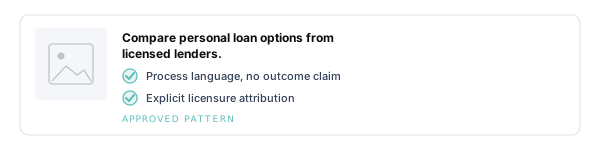
Approved ad-pattern for GLP-1: process language with licensure attribution

Across the GLP-1 telehealth accounts we track, these phrasings pass review consistently when paired with proper landing-page compliance. Each aligns with the signals Meta's review reads through the Enforcement Signal Layer to keep the account in the clean lane.

  • "Online weight loss treatment"
  • "GLP-1 medication, prescribed by licensed clinicians"
  • "Telehealth weight loss program"
  • "Board-certified physician reviews your case"
  • "FDA-approved Wegovy® for chronic weight management" (only if the ad is actually for Wegovy and the advertiser holds pharmacy authority)
  • "Compounded semaglutide, not FDA-approved, prescribed off-label by licensed providers" (with the disclaimer explicit)
  • "Medical treatment provided by licensed providers"
  • Process language: "Quick consultation," "Personalized treatment plan," "Medication delivered to your door"

These have a documented approval-survival track record. They are not a guarantee (categorical enforcement means even compliant patterns occasionally get rejected), but they are the baseline from which compliant copy starts.

SECTION 04 · Auto-reject list

Language patterns that auto-reject

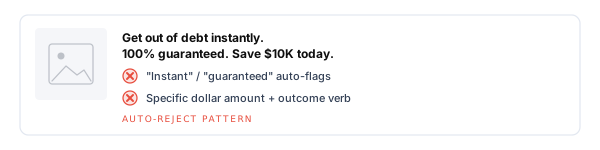
Auto-reject ad-pattern for GLP-1: instant guaranteed dollar-outcome language
  • Direct weight-loss outcome claims ("Lose 30 lbs in 60 days"): misleading-claims or prohibited-health-content policy family
  • Before-and-after imagery (any visible body-shape transformation): auto-rejected at very high rates
  • Personal-attributes targeting language ("Are you overweight?" / "Tired of being obese?"): personal-attributes policy
  • Brand-drug references without pharmacy authority: auto-flagged regardless of context
  • Quantified efficacy claims with specific percentages or pounds: heightened review even when factually accurate
  • Conflation of compounded medications with brand-name approved drugs: auto-rejected
  • Drug imagery (pills, syringes, vials): auto-flags in most contexts

If a creative includes any of these patterns, expect rejection. The fix is creative-level, not appeal-level: the underlying signal Meta's enforcement system is detecting is correctly identified. Rephrasing after the fact does not clear the signal; the pattern needs to be absent from the ad at submission.

SECTION 05 · Landing-page compliance

Required landing-page elements

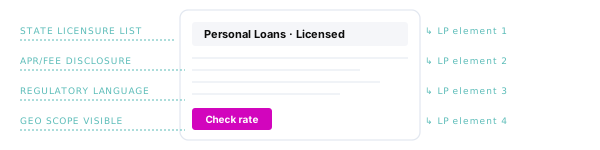
GLP-1 landing-page compliance elements checklist

Telehealth weight-loss and GLP-1 landing pages consistently survive enforcement when they include these elements. Meta's review process reads the landing page as part of the ad review surface, and the landing-page signals feed into Asset Risk Propagation across the connected asset graph.

  • Prescription-required language. "Prescription medication available with valid consultation," explicit on every page that mentions GLP-1.
  • Licensed-provider documentation. Provider credentials visible, state licensure visible.
  • FDA disclaimer for compounded products. "Not FDA-approved. Prescribed by licensed clinicians off-label."
  • Clinical / regulatory tone, not direct-response marketing tone. Use the language a telehealth practice would use, not the language a supplement DTC would use.
  • No before-and-after imagery on the landing page. The landing page is part of Meta's review surface, not separate from it.
  • No quantified outcome claims in headline or hero.

Compliance work that stops at the ad creative without addressing the landing page misses a structural part of Meta's review surface. Asset Risk Propagation reads them together: a high-converting landing page with compliance gaps propagates risk back to the ad set and eventually to the ad account.

SECTION 06 · Vertical-specific recovery

Recovery path when this vertical's accounts hit enforcement

When a GLP-1 telehealth account hits enforcement, the recovery sequence is vertical-specific. The generic Ads Manager rejection message is usually not specific enough to anchor the appeal. The underlying violation code, the specific creative element that triggered it, and the compounded-vs-FDA-approved status of the product all determine the outcome.

1

Surface the actual violation code.

The Ads Manager message will say something generic about health claims; the underlying code is more specific (misleading claims policy vs prohibited-health-content policy vs personal-attributes policy are different appeal anchors), and it is readable in the Enforcement Signal Layer directly.

2

Map the code to the creative element that triggered it.

Was it the headline? The image? The landing-page hero? Each triggers different codes.

3

Anchor the appeal to the code, not the Ads Manager message.

Cite the specific carve-out that applies: compounded-prescription documentation, licensed-provider attestation, or FDA disclaimer language.

4

If the account is restricted (not yet suspended), address at the restriction stage.

Across the accounts we monitor, most suspensions follow an earlier restriction signal, typically inside the 30-day window before terminal action. Restrictions are the leading indicator. The prediction is legible in the Graph API before the suspension lands.

5

If a policy-code disablement has landed, the appeal is typically non-appealable.

Recent Meta Pro Team responses confirm this pattern in the GLP-1 vertical. At this point, business-identity reputation is the operational concern: protect remaining ad accounts under the identity before they cascade.

Vertical-observed resolution speed: 5 business days versus 15+ days industry-wide (ComplyAi Intelligence Graph, Q2 2026). The delta is code-anchored appeals: 30 to 35% of adjudicated Meta enforcement decisions overturn on appeal when anchored to the specific violation code, and materially worse when the appeal argues against the generic policy message. For the full cascade mechanics when enforcement escalates to suspension or spend-limit compression, see /solutions/recovery. For the full appeal mechanics, see the Meta Ad Account Reinstatement guide.

Full step-by-step reinstatement playbook lives at Meta Ad Account Reinstatement.

SECTION 07 · Adjacent-vertical patterns

Cross-vertical spillover risk

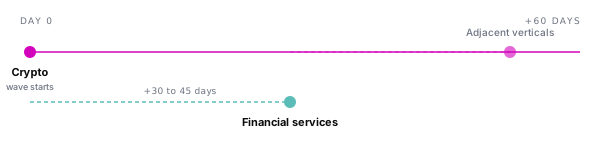
Cross-vertical spillover timeline: CBD then supplements then GLP-1

GLP-1 telehealth does not operate in isolation. The Intelligence Graph observes spillover across adjacent verticals in the Drugs and Pharmaceuticals industry:

  • CBD enforcement waves frequently precede Supplement enforcement waves by approximately 42 days at high confidence. GLP-1 telehealth typically follows the Supplement wave's downstream impact within 30 to 60 days.
  • Compounded-pharmaceutical enforcement is correlated with brand-drug-approval policy shifts. When Meta tightens enforcement on Wegovy or Ozempic advertising specifically, compounded GLP-1 sees secondary tightening within 2 to 4 weeks.
  • Health-claim enforcement crosses vertical boundaries. A wave that hits one health-adjacent vertical typically reaches the other health-adjacent verticals within the same enforcement cycle.

Cross-account pattern detection is the early-warning. Single-account observation misses the wave. Subscribers in this vertical benefit from the cross-account observation surface: the wave that is about to hit your accounts is often visible across the rest of the vertical's monitored accounts first. Reading that signal is what turns a Stage 03 suspension into a same-week correction, and it is why the Pillar 5 hub at /blog/scale-meta-ads-safely frames scaling as a signal-reading exercise, not a spend-management exercise. Ad-spend continuity in this vertical is a signal problem, not a paperwork one.

Weight Loss & GLP-1 FAQ

Frequently asked questions about Meta ad compliance for weight loss and GLP-1 telehealth

Can I advertise GLP-1 medication on Meta?
Yes, with conditions. FDA-approved GLP-1 medications (Wegovy, Ozempic, Mounjaro, Zepbound) can be advertised if the advertiser holds licensed pharmacy authority and the landing page meets prescription-required and licensed-provider documentation requirements. Compounded GLP-1 can be advertised if explicitly disclaimed as compounded and prescribed by licensed clinicians off-label. Both paths require alignment across ad copy, landing page, and business-identity licensure.
Why do my GLP-1 ads keep getting rejected even when the products are legitimate?
GLP-1 sits in Meta's most-policed advertising category. Categorical enforcement means the AI risk model treats GLP-1-adjacent content with elevated scrutiny regardless of how compliant the specific ad appears. Some false-positive rejections are structurally baked in. Anchoring appeals to the specific violation code (not the generic Ads Manager message) materially improves overturn rates.
What's the appeal success rate for GLP-1 enforcement decisions?
30 to 35% of adjudicated Meta enforcement decisions overturn on appeal when properly anchored to the actual violation code (ComplyAi Intelligence Graph, Q2 2026). The GLP-1 vertical specifically sees similar rates with code-anchored appeals and materially worse rates with generic-message appeals.
Can I use brand-name drug references (Wegovy, Ozempic) in my ads?
Only if you hold the licensed pharmacy authority to prescribe and dispense those FDA-approved drugs. Telehealth practices that prescribe compounded equivalents should not use brand-drug names even if the underlying chemistry is similar. Compounded products are enforced as a separate category requiring explicit disclaimers.
What's categorical enforcement?
Categorical enforcement is when Meta's AI risk model applies elevated scrutiny to a vertical regardless of individual ad compliance. The category itself triggers the scrutiny, not the specific creative. GLP-1, CBD, gambling, and adult are the canonical categorically-enforced verticals.
My GLP-1 telehealth account was disabled with a policy-code disablement. Can I get it back?
Likely not via direct appeal. Recent Meta Pro Team responses indicate that policy-code disablements in this vertical are typically non-appealable. The operational focus at that stage shifts to protecting other ad accounts under the same business identity before Asset Risk Propagation cascades to them.
Weight Loss & GLP-1 · Vertical compliance hub

Read the categorical-enforcement signal before the suspension cascade

ComplyAi's Intelligence Graph reads the GLP-1-specific Enforcement Behavior signals across 5,000+ ad accounts observed, surfaces cross-account cascade patterns before they hit your Business Manager, and identifies which of your creative or landing-page elements are drawing categorical scrutiny. From there, the recovery clock is measured in days, not weeks.